
Run an AI Readiness Assessment Before Your Competitors Do
The ROI of AI training is measurable — if you know how to track it. Here is how strategy and HR leaders can build a business case that gets CFO sign-off. Focus Keyword: AI training ROI
Thought leadership, research, and updates from the forefront of AI-powered learning and workforce transformation.

The ROI of AI training is measurable — if you know how to track it. Here is how strategy and HR leaders can build a business case that gets CFO sign-off. Focus Keyword: AI training ROI

Most AI training fails to change how people work. Here is why our approach is different — and what 93% satisfaction across thousands of professionals tells us about what actually works.

Operational AI moves artificial intelligence from experimental projects into the core of how an organisation runs. This blog explains what operational AI actually means, how it differs from traditional AI adoption, and why a growing number of enterprises are turning to managed service models to get the outcomes they need without building everything from scratch.

Scaling AI across an organisation is not a single project. It is a multi-phase transformation that requires different leadership skills at each stage. This blog frames the journey in three acts: experimentation, integration, and transformation. It explores what separates organisations that reach full-scale AI adoption from those that get stuck running perpetual pilots.

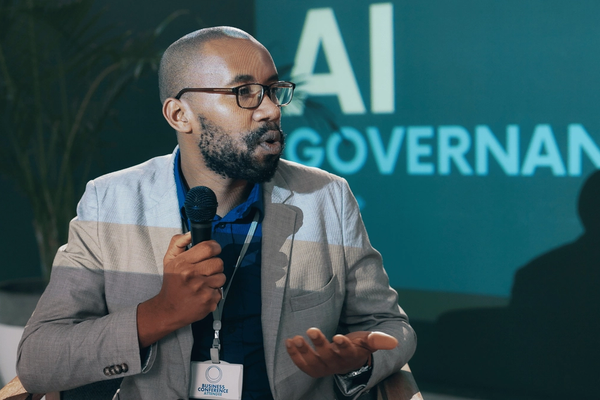
Effective AI governance isn't about restriction — it's about making AI use visible, consistent, and aligned with organisational standards. Frameworks that work are written for practitioners, risk-tiered, accountability-focused, and designed to evolve alongside the technology.

AI awareness training rarely changes how people work. Industry-recognised AI certification builds applied capability, creates credible internal and external signals of AI competency, and gives organisations a durable foundation for scaling responsible AI use.

This blog explains how AI for business data analysis is transforming the role of business analysts from manual reporting to strategic decision-making. Traditionally, analysts spend most of their time cleaning data, building reports, and preparing dashboards—leaving little room for deeper insights. AI changes this by automating repetitive tasks (up to 30–40%), enabling analysts to focus on higher-value work such as pattern recognition, forecasting, and business strategy.

A case study of how Kydon Group designed and delivered AI training to all 1,500 employees of a professional services firm in under 12 months. The piece breaks down the three-pillar approach — role-relevant content, cohort-based delivery, and phased rollout — and shares measured outcomes including a 41% reduction in time on manual tasks and 27% improvement in project efficiency. It closes with four lessons on what made enterprise-wide AI training stick.

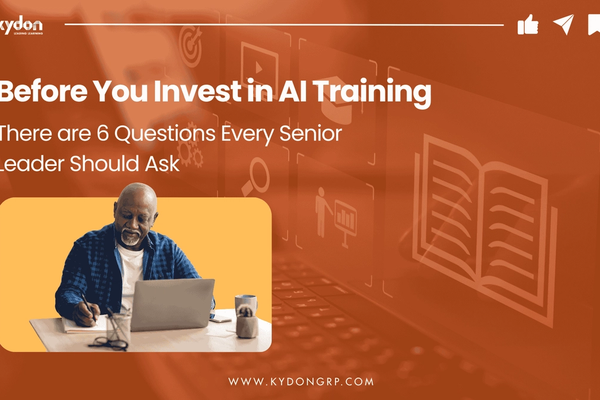
This soft-sell blog post targets senior leaders evaluating AI training investments. It walks through six critical questions organisations should answer before committing budget: defining AI literacy for their specific context, distinguishing skills gaps from mindset gaps, establishing a measurable AI vision, moving beyond module completion as a metric, deciding between adoption and transformation, and identifying blind spots. Each question is supported by 2025 research (Data Society, Kyndryl, IDC, Mercer, Salesforce). The post closes by positioning Kydon Group's complimentary AI Readiness Consultation as a no-pressure starting point for leaders who want clarity before they invest.

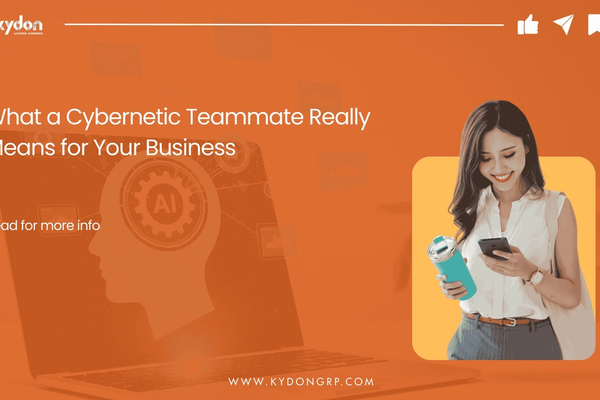
This blog post introduces the concept of the "cybernetic teammate" based on a 2025 Harvard-P&G study involving 776 professionals. The key finding: one person working with AI matched the output of a traditional two-person team, with nearly 40% performance improvement. More significantly, AI dissolved professional silos — R&D and commercial specialists both started producing balanced, cross-functional solutions when working with AI. The post argues that organisations need to move beyond using AI as a shortcut and instead build genuine human-AI team capability through AI literacy, restructured teams, and intentional training. It closes with Kydon Group's positioning as a partner for organisations ready to develop this capability.


Leaders who embrace AI aren't undermining their authority — they're extending it. Drawing on research from McKinsey, Gartner, HBR, and MIT Sloan, the article argues that the real credibility risk lies in being the last leader to adopt AI, not the first. Strategic AI literacy helps executives make faster, sharper decisions while keeping human judgment at the center.

Are your leaders truly equipped to make strategic AI decisions? Most executive AI education stops at surface level awareness. Learn how practical AI leadership training provides the decision frameworks and strategic fluency needed to drive real organizational transformation.

AI training is just the beginning. Why do so many teams revert to old habits weeks after a workshop? Uncover the four crucial steps—practical application, workflow integration, leadership reinforcement, and measurement—needed to turn AI skills into a sustained competitive advantage.

Are your employees actually using their AI tools? Most AI training focuses on awareness, leaving adoption rates to collapse after just a few weeks. Read our guide to find out why corporate AI training fails and how to build habit loops that embed AI into daily workflows for lasting impact.

Struggling with AI adoption? The 4-Week AI Jumpstart provides a clear, week-by-week roadmap for teams. Learn how to assess your team's baseline, master relevant tools, integrate AI into daily workflows, and track ROI for lasting productivity.
Get the latest insights on AI-powered learning delivered to your inbox
Subscribe to Updates